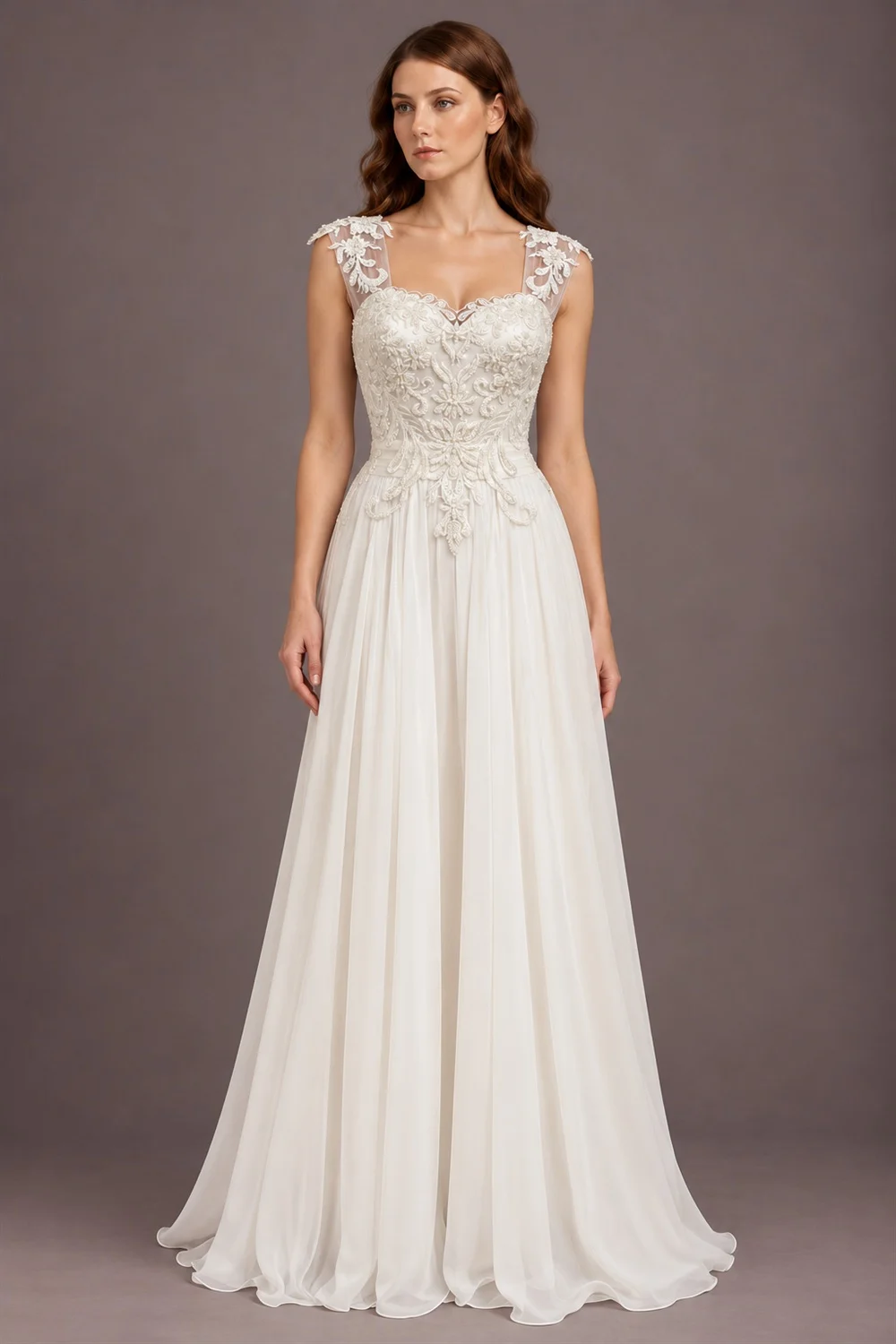
The neckline is the part of the dress you see most often, both in the mirror and in photographs, yet it is hard to choose from a still image. What matters is how it behaves as you walk, sit down, embrace your parents or raise a glass. Below are four common necklines, how each one sits and what is worth checking at your fitting.
What a neckline actually does
The neckline sets where the eye comes to rest: at the throat, the collarbones or the shoulders. It also determines how well the dress stays in place on its own. A high neckline, or one with wide straps, rests on the shoulders. A strapless one relies on the corset and the cut around the bodice. That is why two dresses with the same skirt can feel very different to wear.
Three more things are worth considering from the outset: jewellery (a necklace calls for a more open or simpler neckline), your hair (an updo leaves the whole area on show) and the veil, which is usually fixed high with a comb and can cover or obscure the line of the neckline.
The sweetheart neckline
The line forms two gentle curves with a small dip at the centre. It is often found on corseted dresses, because a bodice shaped with boning or an inner structure needs a clean edge. On the Love 306 wedding dress, for example, the hand-embroidered sweetheart corset is paired with tulle straps finished with appliqués, and the back laces up. At the time of writing, the size available is 36.
At your fitting, check the top edge of the corset: it should sit flush, without lifting away when you breathe deeply or lean forward. Then raise your arms as if going in for a hug. If the bodice rides up or shifts, tell the seamstress exactly where you feel the movement; it can often be resolved by adjusting the straps or the corset. You will find more on the role of the inner structure in our article on the corset of the dress.
The V-neck
The vertical line lengthens the neck and opens up the décolletage without leaving the shoulders entirely bare. It can be subtle, just a slight dip, or very deep, at the front and the back. The two wear quite differently: a deep V needs more attention to how the fabric lies across the chest, especially if the bodice is made from a delicate fabric, while a subtle V is easier to wear all day.
As you move, watch for two things. First: do the edges of the V stay in place when you lean forward or climb a step, or do they gape? Second: what can be seen from the side? Take a photo on your phone from the angle your guests will be photographing you from, and you will see straight away. If you are finding it hard to decide how deep you want the neckline, talk through what can be altered at your fitting; you will find a list of useful questions in our article on personalising the neckline, sleeves and length.
The bateau neckline
The line runs from one shoulder to the other, almost horizontally, and covers the collarbone. It gives a clean, linear look and works well with a simple skirt. The Love A45 dress has a bateau neckline with a small split, combined with duchess taffeta and a pleated skirt with pockets. At the time of writing, size 38 is available ready to wear, and other sizes or shades can be made to measure, according to the catalogue description.
A bateau neckline restricts arm movement more than you might expect. Raise both arms, bring them forward and cross them, as you would on the dance floor. If you feel the fabric pulling at your shoulders, that is no sign the dress is not for you; it is precisely the information the seamstress uses to adjust the cut around the arm and shoulder.
Strapless and off-the-shoulder
A straight or heart-shaped strapless neckline leaves the shoulders and arms free. It is held up by the corset rather than the shoulders, and how well the corset fits at the waist and over the ribs decides how secure you feel. When the support is well made, the bodice stays in place without you having to hitch it up every few minutes.
The useful tests here are simple: breathe deeply, sit down on a chair, walk a few steps, then raise your arms. If the bodice slips or leaves marks that bother you, discuss the alternatives: thin detachable straps, a separate sleeve or a different type of corset. If you would like a point of reference, the Love 307 dress is described in the catalogue as a 2-in-1, with a detachable strapless corset and a choker, but what can be altered on it is decided with the atelier, not from a photograph.
The five-step check
- Breathe deeply and sit down. The neckline should stay in place in both positions.
- Raise your arms. The bodice and straps should not shift, and the movement should not pull at the shoulder.
- Lean forward. Check in the mirror, and with a phone, what can be seen from the front and the side.
- Put on your jewellery and veil. With them on, the line of the neckline looks different.
- Walk a few steps. The neckline should not slip, twist or feel tight.
What can be adjusted
A neckline can often be reworked or adjusted: the straps can be moved, the depth altered, the edge raised or lowered. What is possible depends on the dress, the fabric and how the bodice is constructed, so it is not worth relying on a general rule. Say at your fitting what bothered you, and let the seamstresses explain what can be done and what would change the cut too much.
If you would like to see them on yourself, book a fitting at the showroom and try the necklines one after another, with your arms raised and seated on a chair. Then look through our wedding dresses for the ones that caught your eye.
TO BRING TO YOUR FIRST MEETING
- The images that inspire you, and your questions.
- A sense of the occasion and of what makes you feel comfortable.
- The details you would like to discuss with the atelier.