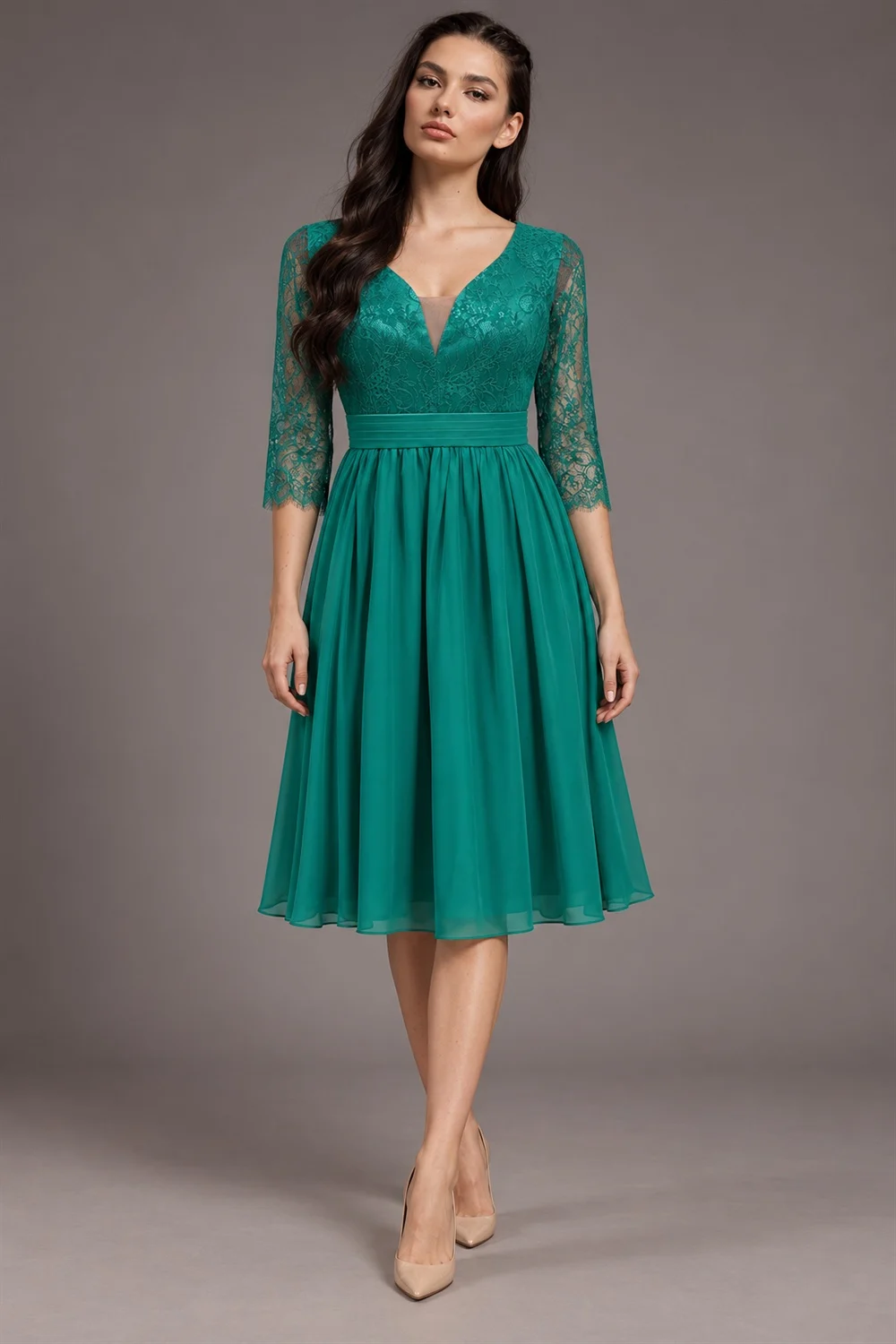
The couple’s godmother, the nașă, appears in almost every important photograph: at the ceremony, beside the couple as guests offer their congratulations, at the cutting of the cake. Her dress is seen close up and for hours, so it deserves more thought than one worn simply to sit at a table. The aim is not to go unnoticed, but to look polished while leaving the bride at the centre of the frame.
Start with colour, then think about shine
White, cream, ivory and very pale champagne are the safest to avoid, even if the shade looks different to you. Under a camera flash and in a photograph, light tones drift closer together than you might expect. On a long dress, the risk shows most on the upper body, which is where the eye settles first.
Rich, deep shades sit more quietly beside a white dress: navy, emerald green, deep cherry, dark purple. Powdery pastels can work, but try them in natural daylight, not only under the showroom lights, as some lose their colour entirely in photographs.
The second consideration, just as important, is how the fabric reflects light. Large sequins, high-shine satin and dense embroidery with crystals draw the eye even in a dark colour. Matt lace, fine chiffon or a taffeta with a soft sheen give elegance without competing with the bride’s embellishment. If it helps, read also how to judge the sparkle of a sequinned dress, as the same principle applies to any fabric with a sheen.
Length and silhouette for a day in several stages
A wedding day usually means the ceremony, photographs, getting in and out of the car, dinner and dancing. The nașă moves more than an ordinary guest, as she is often on her feet, greeting people and accompanying the couple. That is why the first test is how the dress behaves when you do four things in a row:
- walk up and down three or four steps, as at the entrance to a church or a venue;
- sit down and stand up from a chair without holding the fabric in your hand;
- raise your arms, as you would for an embrace or to take a photograph;
- take a few quick steps and turn sharply.
A midi dress, with the hem below the knee, is easy to wear through all of this. A long dress can be just as elegant, but check its length with the shoes you will actually wear on the day, not another pair. A few centimetres of heel change the way the hem falls, and a skirt that is too long gets trodden on at the stairs and dirtied on the kerb at the entrance.
Shoulders and arms matter more than you think
If the ceremony takes place in a church, many women choose to cover their shoulders, whether with sleeves, a jacket or a wrap. It is not a written rule for everyone; it depends on the church and the officiating priest, so it is worth asking in advance. A dress with three-quarter or long sleeves solves the question without an extra accessory, and in the evening it means you are not left without something on your shoulders when the air cools.
At the fitting, check whether the sleeve tightens when you lift your arm and whether the neckline stays in place. A V-neck can be a very good choice, provided it lies flat even when you lean towards a shorter bride or groom, or towards a child. For more on how to check a dress with sleeves, our article on wedding dress sleeves describes the same movements, which you can just as easily try in an evening dress.
Two dresses from the collection, as examples of cut
This is not a buying recommendation, but an illustration of the points above, based on details confirmed in our catalogue.
The Amour 46 evening dress is a midi in emerald green, with a Chantilly-style lace bodice and three-quarter sleeves, a V-neck, a pleated waist and a floaty skirt in fine chiffon falling to below the knee. It pairs a sleeve and a comfortable length with a dark colour and a matt fabric. It is priced at 1500 lei and, at the time of writing, is available in a size 44.
For those who prefer a floor-length dress, Amour 34 is long and navy, with a bodice and three-quarter sleeves in embellished embroidered lace, a V-neck, a pleated waist and a full skirt in fine chiffon. It costs 2500 lei; at the time of writing it is available in sizes 46 and 48, and the design can be made to measure in other shades or sizes.
Comfort, because the day is long
The nașă cannot slip away quietly after two hours. Check that the waist does not become uncomfortable after dinner, that the fabric does not crease visibly around the hips when you are seated, and that the bodice stays in place without constant adjusting. A fabric with some stretch helps, but it is no substitute for a cut that fits well from the outset.
Think, too, about what you will wear over it: a coat for the journey to church or for photographs outdoors. A dress with sleeves sits well under a light coat, whereas one with volume at the shoulder can be flattened. If, after the fitting, you notice that the length, waist or shoulders need adjusting, our evening dress alterations service is the place to discuss what can be changed. The time needed depends on how much work is involved, so it is best to book well ahead rather than a few days before.
Coordinating with the bride without spoiling the surprise
You do not need to know what the bride’s dress looks like in order to choose well. It is enough to ask whether there is a main colour for the wedding, whether the couple have chosen colours for the ceremony or the décor, and whether there is a dress code. If the invitation specifies one, our guide to dress codes will help you gauge the level of formality. With this information you can avoid two things: wearing the same colour as the bride, and a stark contrast with the rest of the close wedding party.
If you would like to try on a few options in person, in different colours and fabrics, you can book a showroom appointment. Bring your shoes and, if you have them, the jewellery you plan to wear; they almost always change what you choose.
TO BRING TO YOUR FIRST MEETING
- The images that inspire you, and your questions.
- A sense of the occasion and of what makes you feel comfortable.
- The details you would like to discuss with the atelier.