A ball gown is judged at three moments: when you walk into the room, when you dance and when you sit down at the table. A catalogue photograph shows only the first. So before you think about colour or style, it is worth asking yourself how you want to move on the night.
The silhouette changes the way you move
Cut is about more than a beautiful line on the hanger. Each silhouette asks something different of you: your stride, the space around you, the way you take a staircase.
Mermaid silhouette: a long line, measured steps
A mermaid cut follows the body down to around the knee, then flares out. The effect is one unbroken vertical line, and its elegance comes from that simplicity. The trade-off is a shorter stride, so stairs and dancing need a different approach. At your fitting, don’t stop at the mirror. Take a few steps, climb a step if there is one to hand, and sit down. Check that the fabric stretches without pulling and that you can breathe normally when seated.
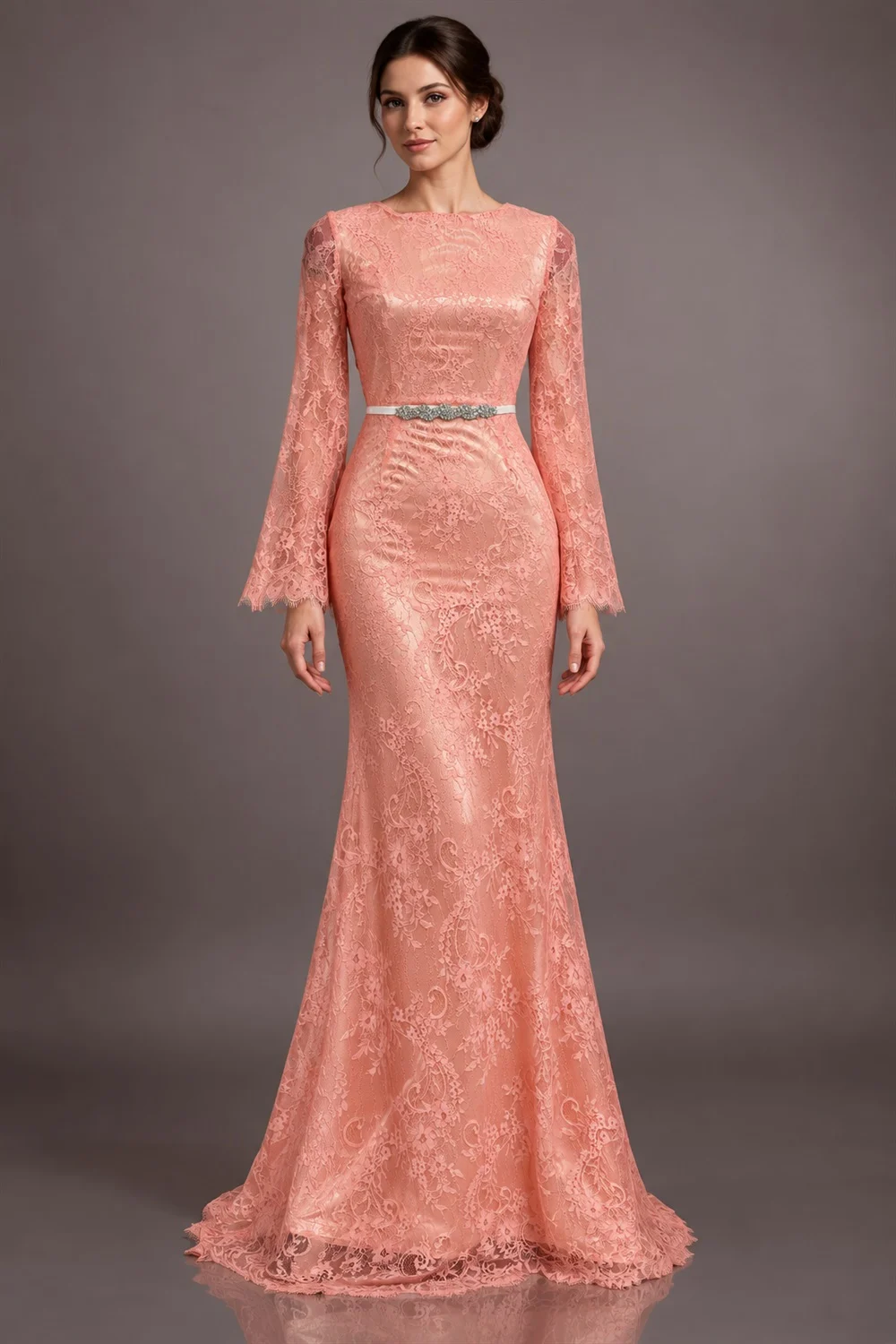
One example from the showroom is the Amour 10 evening dress: a long coral gown in a mermaid cut, in Chantilly-style lace over stretch satin, with long flared sleeves and an embellished belt at the waist. It is a one-of-a-kind piece in size 38, priced at 2,000 lei, and can be made to measure in other shades or sizes. The flared sleeves bring movement to the upper half, so the close-fitting silhouette never looks rigid.
Full skirt: freedom and volume
If you long to dance without a second thought, a full skirt leaves your steps free. The volume comes from the fabric and from the way the skirt is constructed: stretch taffeta holds its shape, while chiffon falls more softly and moves with every step. At the fitting, your aim is to see how the skirt behaves when you turn quickly, and how much fabric you have to gather in your hand to climb a step.
On the Amour 26 evening dress (long, mauve, 2,800 lei, size 42, one-of-a-kind), the bodice and three-quarter sleeves are embroidered and hand-embellished with sequins, the neckline is a V, and the full skirt is fine, silky chiffon over stretch taffeta. It is a study in contrast: a worked surface above, a skirt that moves lightly below.
Colour is read through the fabric
The same shade looks different on taffeta, chiffon, velvet or lace. Taffeta catches the light in broad folds and makes colour look more intense. Chiffon filters it and softens it. Velvet absorbs light and deepens the tone, while lace lets what lies beneath show through, so the shade also depends on the lining underneath.
In practice, coral on lace and satin will not look like coral on glossy taffeta, even if the shade has the same name. So look at the dress in its own fabric rather than at a colour swatch, and ask to see it both in natural daylight by the window and under the showroom lights.
How to choose the colour for your evening
There is no ‘right’ colour for a particular complexion or figure. There are, however, a few practical pointers that will help you decide:
- The lighting in the venue. In rooms with warm, low lighting, dark shades (navy, green, black) drift towards one another and lose contrast. Lighter or brighter colours stay visible.
- Photographs. A flash can alter a pastel shade. If you want to look the same in photographs as you do in the mirror, take a test shot on your phone, with and without flash.
- Accessories. The shoes, bag and jewellery you already own can narrow or widen your choice. If you have a favourite pair, bring them to the fitting.
- How you feel in it. A colour that seems ‘safe’ but doesn’t excite you shows in your posture. One you love wearing shows just as quickly.
Ball gowns also suit bolder shades than you might wear day to day, and the evening is more forgiving of a vivid red or green. But don’t push yourself towards a tone simply because it is in fashion.
What to check at your fitting
- Walking and stairs. Take long strides, as you would when crossing a room, and climb a step. If you tread on the hem or it catches, say so straight away.
- Sitting. Sit on a chair for at least a minute. The fabric should not pull at the hips, and the bodice should not ride up.
- Arms. Raise them as if for an embrace or a dance. Do the sleeves and neckline stay in place?
- Support. If the dress is strapless, see how the bodice holds as you move. We have written about structure in more detail in our article on the corset of a dress.
- Colour in motion. Turn slowly in front of the mirror. The shade changes with every fold.
Alterations: what to discuss before you decide
A ball gown rarely fits perfectly straight off the hanger, and there is nothing wrong with that. Hem length, waist height and the width of the straps or sleeves are all routine alterations. What matters is discussing them at the fitting and finding out what can be altered, given the cut and the fabric: embroidered lace or a layer of chiffon is adjusted differently from plain taffeta. The time needed depends on how many alterations there are and what they involve, so ask early and leave yourself plenty of time before the date of the event. You will find details of the work that can be done on our evening dress alterations page.
To see more long styles, you can start with the evening dress collection. Sizes and shades vary from one style to another, and some can also be made to measure.
If you already have a silhouette or colour in mind, bring the idea to a fitting at the atelier. You can compare the options one by one, wearing the right shoes, and decide by how you feel in motion, not just in the mirror.
TO BRING TO YOUR FIRST MEETING
- The images that inspire you, and your questions.
- A sense of the occasion and of what makes you feel comfortable.
- The details you would like to discuss with the atelier.